Understanding innovation-driven economic growth on which 2025 Nobel prize was awarded to Joel Mokyr, Philippe Aghion, and Peter Howitt.
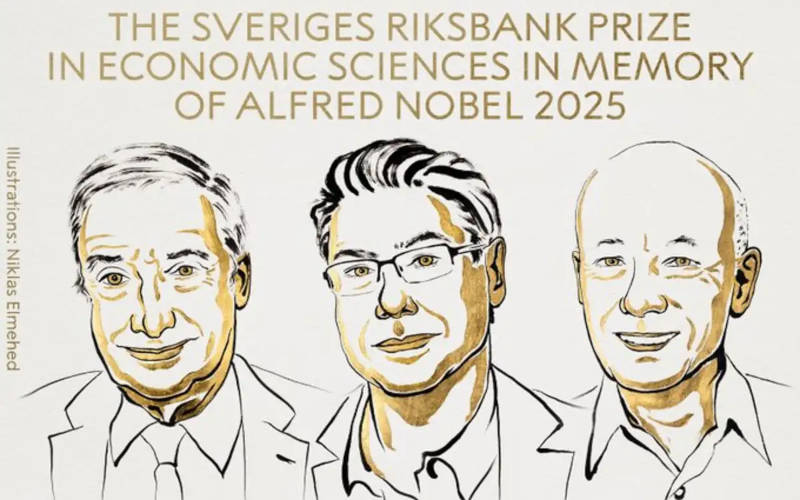
Who Won & What They Were Awarded For
The 2025 Nobel Prize in Economic Sciences was awarded to three economists: Joel Mokyr, Philippe Aghion, and Peter Howitt. They were recognized “for having explained innovation-driven economic growth.”
- Joel Mokyr got one half of the prize for identifying the prerequisites for sustained growth through technological progress.
- Philippe Aghion and Peter Howitt shared the other half for their work on the theory of creative destruction — a framework showing how the constant replacement of old technologies/businesses by new ones drives growth.
What Are the Key Ideas
To appreciate this prize, it helps to understand two related concepts and how the laureates contributed to them.
- Prerequisites for Sustained Technological Progress (Mokyr’s contribution)
Mokyr uses historical analysis to show that for technological progress to become self-sustaining (i.e. continuous growth rather than one-off spurts), certain conditions are needed:
- A culture and institutions that value scientific inquiry and explanation — not just “this works,” but “why it works.” Understanding the underlying science allows building on previous gains.
- Mechanical competence & technical skills — people must be able to experiment, to tinker, to implement innovations.
- Openness to change — societies that allow disruptive ideas, are tolerant of novelty, and permit “creative destruction” to happen without excessive protectionism or rigid structures. Mokyr’s historical lens shows that before the Industrial Revolution, though there were many innovations, growth often stalled. Sustained growth only became more “normal” when those prerequisites were in place.
- Creative Destruction (Aghion & Howitt’s theory)
This idea, originally from Schumpeter, describes how new innovations replace old ones: new firms/products/technologies come up; older ones lose out and either adapt or vanish. It’s disruptive, but that disruption is a source of growth.
- Aghion & Howitt formalized this idea mathematically (not just qualitatively), in particular with a model (from ~1992) showing under what conditions this process leads to sustained growth.
- Their model shows how competing firms invest in innovation despite the risks: a firm might innovate knowing it could be displaced too, but with sufficient incentives, the overall economy advances. It also highlights consequences: if firms or industries are too protected, or if there are barriers to entry, innovation can be stifled; growth slows.
Also read: Sentiment Analysis in Banking
Why It Matters
Why is this work important — especially for students, policy-makers, and anyone interested in economics or innovation?
- Explains Why Growth Takes off: For most of human history, the standard of living changed slowly. Only in relatively recent centuries have many societies seen sustained growth. Understanding what turned stagnation into sustained growth helps explain why some countries developed faster and others lagged.
- Helps in Policymaking:
• Government policies on education, research funding, intellectual property, competition law, regulation of markets — all can either foster or hinder innovation. If you know what conditions are needed (as Mokyr, Aghion & Howitt elucidate), you can design better institutions.
• Managing the downside of creative destruction — loss of jobs in old industries, short-term disruptions — becomes part of policy concerns. Safety nets, retraining, mobility, etc. are necessary.
- Relevance to Today’s Challenges & Technologies: We live in an era of rapid technological change — AI, biotechnology, clean energy, robotics. The questions raised by the laureates are directly relevant: how do we ensure continuous innovation; avoid monopolistic stagnation; balance old vs new; make sure society gains broadly, not just a few firms.
- Warning Against Taking Growth for Granted: An important theme in the prize announcement is that growth is not automatic. Societies need the right mix of openness, competition, institutions, scientific culture, etc. Threats like protectionism, monopolistic firms, resistance to change can bring stagnation.
Some Examples to Illustrate
To better grasp these ideas, here are some clearer, more concrete examples:
- Historical transition: Before the Industrial Revolution, many useful inventions existed (e.g. watermills, windmills, printing presses), but often without the scientific understanding or the institutional environment to build upon them in a sustained way. After things like the Enlightenment, scientific societies, broader literacy, patents, better education — all helped. Mokyr stresses precisely such shifts.
- Business disruption: Think of how the smartphone replaced many earlier technologies (cameras, calculators, MP3 players). Or how streaming disrupted video rental stores. Or how electric vehicles threaten traditional auto industry supply chains. These are modern cases of creative destruction.
- Competition & entry barriers matter: In tech, firms that dominate a market (e.g. “superstar firms”) can sometimes stifle further innovation, because new firms find it hard to enter or face unfair competitive disadvantages. Aghion & Howitt’s models suggest that allowing entry, ensuring competition law, avoiding over-protection is essential.
Also Read: Kaplan-Meier Model for Survival Analysis in Banking
Some Key Takeaways
Here are some lessons or insights you might carry forward:
- Interdisciplinary approaches help: Mokyr uses history + scientific understanding; Aghion & Howitt use formal mathematical models. Combining history, theory, and empirical work often provides deeper understanding than any one approach alone.
- Institutions & culture are crucial: Not just technology itself, but whether a society values science, tolerates dissent, allows change, supports risk-taking, etc. These non-economic factors matter a lot.
- Innovation has costs and benefits: While growth overall generally improves welfare, there are losers: obsolete industries, workers whose skills are no longer in demand, etc. Policies must address those.
- Policy design needs nuance: For example, subsidies for R&D make sense, but too much protection for incumbents may hinder new entrants. Regulation may be needed to ensure healthy competition. Also, investment in education and infrastructure matters.
- Growth is not automatic: You can’t assume that because technology exists, growth will continue. Threats include monopolies, lack of scientific openness, barriers to knowledge sharing, institutional inertia, poor governance. Recognising this helps avoid complacency.
Open Questions
No theory is perfect. Some of the open areas or debates include:
- How to measure innovation’s impact properly (especially in services, in intangible goods, digital platforms). Some innovations are hard to quantify (e.g. improvements in user interface, software).
- How to ensure innovation is inclusive — i.e. benefits many people, not just those in high tech or well-off sectors.
- Environmental constraints: How does innovation and growth align with climate change, sustainability? Sometimes growth has negative externalities.
- How to manage the social costs of creative destruction: displacement, inequality, regional disparities.
Conclusion
The 2025 Nobel Prize in Economics reminds us that innovation is a central engine of long-term growth, but that its power depends on much more than inventing new gadgets. It requires scientific understanding, supportive institutions, competitive markets, openness to change, and policies that help societies absorb and adapt to change. As students, this offers both inspiration (lots of possibility) and a clear sense of what challenges need attention.
If you are studying economics, tech policy, history, or related fields, the laureates’ work is a rich source of ideas. Understanding them can help you think about how your own country (or the world) can foster innovation that leads to broadly shared prosperity, without falling into stagnation or inequality traps.
Information sources:
1. phys.org
2. indiatoday.in
3. ft.com
4. apnews.com