Agentic AI in banking transforms complex workflows from AML to underwriting. Multi-agent architecture and safety guardrails required for compliance.
If you’ve spent any time working at the intersection of finance and technology over the last decade, you’ve witnessed a predictable cycle. Every few years, a new acronym promises to finally kill off the mountain of manual work clogging banking operations. First, it was Robotic Process Automation (RPA). Then it was Intelligent Document Processing (IDP). Most recently, it’s been generative AI wrappers designed to summarize internal PDFs or draft basic customer responses.
Yet, if you walk into the risk management, compliance, or trade finance department of any major global bank today, what do you see? You see brilliant, highly paid human beings acting as data mechanics. They are still copying data from one system, verifying it against a regulatory checklist in another, cross-referencing it with an Excel sheet, and manually drafting exception reports.
Our current automation tools are hits at the low-hanging fruit, but they hit a brick wall when they encounter complex, multi-step, non-linear workflows that require judgment, memory, and adaptation.
Enter Agentic AI.
This isn’t just another flavor of Generative AI. It represents a fundamental paradigm shift from assistive technology (think chatbots and copilots) to autonomous systems. In this post, we’re going to break down exactly what Agentic AI is, why it is uniquely suited to solve the banking sector’s most intractable workflow problems, how it differs from traditional automation, and the architectural and cultural blueprints required to deploy it safely in a highly regulated environment.
1. What is Agentic AI?
Before we dive into banking use cases, let’s clear up the terminology. The tech industry is notorious for muddying definitions, and “AI Agent” is currently fighting “Enterprise Knowledge Graph” for the title of most overused buzzword.
To understand an AI Agent, it helps to compare it to the Generative AI tools we’ve become accustomed to over the past few years.
+———————————————————————–+
| Copilots / Chatbots (Predictive/Assistive) |
| – User inputs a prompt -> Model outputs a direct response. |
| – Stateless; no memory of broader operational context. |
| – Cannot execute external actions without direct user intervention. |
+———————————————————————–+
vs
+———————————————————————–+
| Agentic AI (Autonomous/Goal-Oriented) |
| – User inputs a high-level goal -> Agent defines the steps. |
| – Loops continuously: Perceive -> Plan -> Action -> Reflect. |
| – Uses tools (APIs, databases, software) to execute workflows. |
+———————————————————————–+
An AI Agent is an autonomous entity powered by a foundational model (or a collection of fine-tuned models) that is designed to achieve a specific goal. Instead of requiring step-by-step instructions, you give the agent an objective, a set of constraints, and access to a toolkit. The agent then figures out the how on its own.
The Core Anatomy of an AI Agent
An enterprise-grade AI agent relies on four foundational pillars:
- The Brain (LLM/Foundation Model): This handles the reasoning, semantic understanding, and decision-making.
- Memory Systems: * Short-term memory: Keeps track of the current multi-step workflow context (e.g., “I am currently on step 4 of verifying this trade bill of lading”).
- Long-term memory: Retains historical context, past mistakes, and organizational knowledge bases via Vector Databases and RAG (Retrieval-Augmented Generation).
- Planning & Reflection Modules: This is the secret sauce. Advanced agents don’t just spit out the first answer they think of. They use frameworks like Chain-of-Thought (CoT) or Tree-of-Thoughts (ToT) to break down a complex goal into sub-tasks. Crucially, they possess self-reflection capabilities—they can evaluate their own intermediate outputs, realize they made an error, and pivot their strategy.
- Tool Execution (Function Calling): This is what transforms a passive model into an active worker. Through APIs, database connectors, and RPA bridges, an agent can read emails, query SQL databases, run Python scripts to analyze data, check regulatory web portals, and update core banking systems.
2. Why Traditional Automation (RPA) Fails the Modern Bank
To appreciate why banks are betting big on agentic frameworks, we have to look at where traditional automation falls short.
For years, banks relied heavily on RPA (Robotic Process Automation). RPA is fantastic for deterministic, rule-based tasks. If X happens, do Y. Copy this cell from Excel, paste it into SAP. It works beautifully—until a single user interface element changes by two pixels, or an incoming document formats a date as DD/MM/YYYY instead of MM/DD/YYYY. RPA is brittle because it lacks cognitive flexibility. It cannot handle ambiguity.
Then came the GenAI Copilot wave. Copilots solved the cognitive flexibility problem. They could understand messy human language, summarize massive documents, and draft emails. But Copilots have a different flaw: they are passive and human-dependent. They sit there waiting for you to type a prompt. If a workflow requires 45 steps across 6 different applications, a human has to sit there “copiloting” the AI through all 45 steps, cutting and pasting prompts. It becomes an ergonomic nightmare that creates new kinds of fatigue.
The complex workflows of banking—commercial loan underwriting, anti-money laundering (AML) investigations, trade finance reconciliation—exist precisely in the gap between RPA and Copilots. They require both the systematic execution capability of RPA and the cognitive adaptability of GenAI. That gap is exactly what Agentic AI fills.
Also read: Model Risk Management, A Crucial Function in Modern Banking
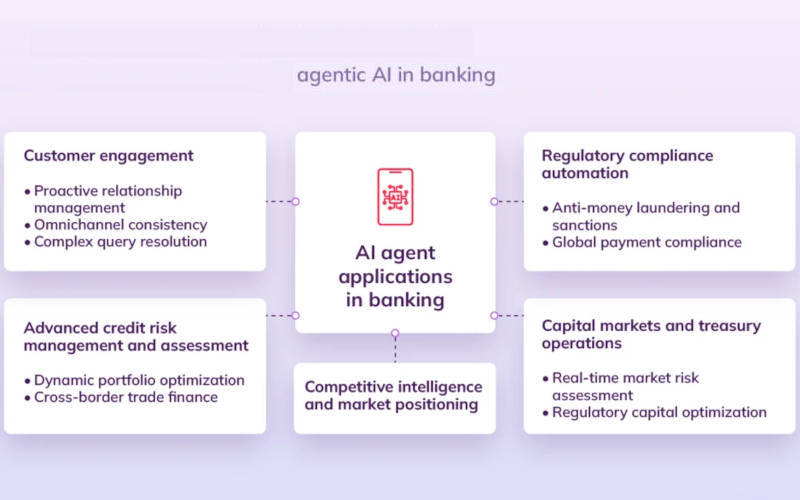
3. Agentic AI in Banking : Use Cases
Let’s move away from theory and look at how multi-agent systems are actually transforming complex, high-stakes banking workflows today.
A. Anti-Money Laundering (AML) Alert Disposition & L2 Investigations
In most global banks, AML compliance teams are drowning. Transaction monitoring systems flag thousands of potential structuring, laundering, or sanctions anomalies every day. Up to 95% of these alerts turn out to be false positives. Yet, compliance officers must meticulously investigate every single one to satisfy regulators.
A traditional Level 1/Level 2 manual investigation looks like this: Open the alert -> query internal customer data -> pull external corporate registry data (e.g., OpenCorporates, Bureau van Dijk) -> search adverse media -> synthesize findings into a Suspicious Activity Report (SAR) or a closure justification. This takes hours per alert.
Here is how a Multi-Agent Architecture transforms this workflow:
              +-----------------------------+
              |  Orchestrator Agent         |
              |  (Receives AML Alert)       |
              +--------------+--------------+
                             |
     +-----------------------+-----------------------+
     |                       |                       |
+——–v——–+ +——–v——–+ +——–v——–+
| Data Extraction | | Adverse Media | | Transaction |
| Agent | | Search Agent | | Analysis Agent |
| – Internal CRM | | – News APIs | | – Python Data |
| – Corp Registry | | – Risk Entities | | Aggregation |
+——–+——–+ +——–+——–+ +——–+——–+
| | |
+———————–+———————–+
|
+————–v————–+
| Compliance Report Writer |
| Agent |
| (Generates Draft SAR/Memo) |
+————–+————–+
|
v
[Human-in-the-Loop Review]
- The Orchestrator Agent receives the raw alert from the transaction monitoring system. It analyzes the alert type (e.g., “Rapid Movement of Funds”) and spins up three specialized sub-agents.
- Agent A (The Data Extractor): Logs into internal CRM systems via APIs to pull the client’s KYC profile, beneficial ownership structure, and expected transaction profile. Simultaneously, it calls external corporate registries to verify if the entity is active.
- Agent B (The Adverse Media Investigator): Uses search tools to scour global news, sanctions lists (OFAC, EU), and politically exposed persons (PEP) databases for any negative mentions of the entities involved. It filters out noise (e.g., people with similar names) by cross-referencing dates of birth or locations found by Agent A.
- Agent C (The Transaction Analyst): Pulls 12 months of historical transaction ledgers, spins up an isolated Python environment to run a statistical anomaly check, and maps out the flow of funds visually to detect hidden circular routing.
- The Compliance Report Writer Agent: Receives the structured outputs from Agents A, B, and C. It synthesizes the evidence, highlights the critical risk factors, references the specific section of the Bank Secrecy Act or FinCEN guidelines, and writes a comprehensive narrative report.
The entire process takes less than three minutes. The human compliance officer is no longer a data gatherer; they are an auditor who reviews the compiled dossier, validates the agent’s logic, and signs off on the final decision.
B. Structured & Unstructured Trade Finance Verification
Trade finance is arguably the most paper-heavy, archaic sector in banking. A single international trade transaction can involve dozens of documents: Letters of Credit, Bills of Lading, Commercial Invoices, Certificates of Origin, and Packing Lists.
To make matters worse, these documents originate from different companies, ports, and jurisdictions worldwide, meaning there is zero standardization. A human examiner must manually verify that the description of goods on the Commercial Invoice matches perfectly with the Letter of Credit, that the weights match across the Bill of Lading and Packing List, and that the shipping vessel isn’t currently docked in a sanctioned port.
An agentic AI system tackles this through semantic cross-referencing and tool-use:
- The agent uses vision-capable foundation models to read and extract data from unstructured documents, regardless of layout variations.
- When it encounters an ambiguity—say, the invoice lists “Rotterdam Marine Grade Steel rods” but the Letter of Credit states “Structural Carbon Steel Wire”—it doesn’t just crash or flag an error. It invokes a reasoning step. It checks internal trade dictionaries, searches industry databases to verify if those terms are commercially equivalent, and tracks down the Harmonized System (HS) tariff codes.
- It then pings an external maritime tracking API (like MarineTraffic) to verify the real-time coordinates of the cargo ship listed on the Bill of Lading, ensuring it has not crossed into embargoed waters.
C. Commercial Real Estate (CRE) & Mid-Market Loan Underwriting
Underwriting a $20 million commercial loan requires a deep dive into financial statements, tax returns, property appraisal documents, local macroeconomic data, and rent rolls.
An autonomous agent workflow can be deployed to dramatically compress the underwriting lifecycle. The agent acts as an elite junior analyst:
- It reads 5 years of audited financial statements, normalizes the line items across disparate accounting formats into the bank’s standard spreading template, and flags any unexplained variances or restatements.
- It analyzes a 500-line tenant rent roll, flags upcoming lease expirations that present a concentration risk, and cross-references tenant names against industry credit ratings.
- It reads local zoning laws and environmental assessment reports, calling out potential liabilities (e.g., historical groundwater contamination mentioned on page 84 of an appendix).
- Finally, it drafts the complete Credit Memorandum, complete with financial ratios, sensitivity analyses under stressed interest rate scenarios, and a localized market outlook summary.
Also read : Roll Rate Analysis and Vintage Analysis in IFRS 9 Credit Risk Models
4. The Architectural Blueprint for Enterprise-Grade AI Agents
You cannot simply give an open-source LangChain agent access to your production core banking systems and hope for the best. Building an agentic system that satisfies enterprise security, compliance, and latency requirements requires a disciplined, multi-layered architecture.
The Multi-Agent Orchestration Layer
For complex workflows, a single monolithic agent breaks down. It suffers from context drift, forgets constraints, and is highly prone to hallucination. Instead, industry best practices dictate a micro-agent architecture managed by an orchestrator framework (such as LangGraph, AutoGen, or CrewAI).
By breaking the workflow down into hyper-focused, domain-specific agents, you drastically minimize the surface area for errors. An agent whose sole purpose in life is to parse corporate tax returns and output a validated JSON schema is far less likely to hallucinate than a generalist agent trying to handle the entire underwriting lifecycle at once.
Dual-System Guardrails and Deterministic Sandboxing
To deploy agents safely, banks must implement a strict decoupling of the Reasoning Layer from the Action Execution Layer.
+————————————————————-+
| REASONING LAYER (LLM) |
| Generates intent: “I need to look up transaction history |
| for account ACC12345 from Jan 1 to May 1.” |
+————————————+————————+
|
v [Strict Semantics/JSON]
+————————————+————————+
| DETERMINISTIC GATEWAY |
| Validates intent against hardcoded RBAC rules. |
| Is ACC12345 within the user’s branch territory? |
+————————————+————————+
|
v [Approved API Call]
+————————————+————————+
| EXECUTION LAYER (Core APIs) |
| Executes read/write operation against backend databases. |
+————————————————————-+
An agent should never write code or execute queries directly against a production database. Instead, the agent’s output should be a structured, declarative intent (e.g., a highly specific JSON payload). This payload passes through a Deterministic Validation Gateway.
This gateway acts as a security firewall, checking the agent’s proposed action against rigid, hardcoded enterprise rules, Role-Based Access Control (RBAC), and transactional limits. If the agent reasons that it needs to transfer funds or pull data outside of its explicitly assigned parameters, the gateway drops the request instantly—regardless of how persuasive the LLM’s reasoning wrapper sounds.
5. Regulating the Autonomous Agent
The technology behind Agentic AI is moving fast, but the regulatory, risk, and operational frameworks inside banks are understandably conservative. To move agentic projects from PoC (Proof of Concept) to production, enterprise tech leaders must directly address three massive hurdles.
A. The “Black Box” Problem vs. Explainability (XAI)
Regulators (such as the Fed, SEC, or ECB) do not accept “the AI told us to do it” as a valid defense for credit denial or an AML oversight. Under regulations like the EU AI Act or FCRA (Fair Credit Reporting Act), decisions must be fully explainable and auditable.
To solve this, agentic workflows must implement Audit-by-Design. Every decision cycle must generate an explicit, immutable Traceability Ledger. This ledger records:
- The exact prompt and system context given to the agent at that step.
- The semantic path evaluated (the Chain-of-Thought logs).
- The specific external tools called and the exact data returned by those tools.
- The self-reflection or correction step taken if an error occurred.
By turning these internal reasoning traces into human-readable logs, the bank can provide a clear, step-by-step audit trail showing exactly why an agent reached a particular conclusion or executed a specific action.
B. Managing Hallucinations and Non-Deterministic Drift
Because LLMs are probabilistic engines, they can occasionally produce different outputs for the exact same input, or worse, hallucinate facts entirely. In a bank, a 1% error rate can translate to millions of dollars in losses or regulatory fines.
Mitigating this risk requires a tiered containment strategy:
- Grounding through Advanced RAG: Ensure the agent cannot invent data by forcing it to anchor every single statement in an extracted, verifiable source document snippet via dense vector embeddings.
- Programmatic Output Verification: If an agent is tasked with extracting numerical financial figures, its output must pass automated cross-checks (e.g., asserting that
Assets = Liabilities + Equityon the extracted balance sheet). If the math doesn’t check out, the validation layer flags it back to the agent for self-correction.
- The Golden Rule: Human-in-the-Loop (HITL): For high-risk, high-impact workflows, agents should be explicitly designed as autonomous preparers but restricted deciders. The agent completes 95% of the heavy lifting, formats the decision memo, compiles the data, but the final button—the actual approval of a loan, the blocking of a client, or the filing of a regulatory report—must be pressed by a certified human operator.
C. Shifting Corporate Culture: From Tools to Coworkers
Perhaps the quietest but most challenging roadblock to Agentic AI adoption is cultural. Employees have spent decades viewing software as a passive tool. You click a button, the software does exactly what that button is programmed to do.
Working with Agentic AI feels entirely different. It feels like managing a highly capable, exceptionally fast, but occasionally distractible intern. It requires human employees to shift their skill sets from execution to delegation, prompt governance, and quality assurance auditing.
Banks that excel in this transition will be those that actively upskill their operations staff to become “Agent Managers”—professionals who know how to set objectives for AI agents, review their logs for reasoning drift, and optimize their toolkits.
Also read: SR 11-7 vs SR 26-2 – Complete Guide to Evolution of Model Risk
6. The Quantitative Impact of Autonomy
Let’s look at the financial reality. Implementing an enterprise-grade agentic framework requires a substantial upfront capital expenditure in infrastructure, model fine-tuning, vector pipeline development, and rigorous security testing. Is the juice worth the squeeze?
When you analyze the data from early adopters in the tier-1 banking space, the return on investment generally maps across three core vectors:
| Metric | Traditional Workflow (Manual + RPA) | Agentic AI Workflow (Multi-Agent + HITL) | Operational Impact |
|---|---|---|---|
| Cycle Time | 4 to 10 Days (e.g., Complex Commercial Underwriting) | 2 to 4 Hours | ~80% reduction in time-to-decision, vastly improving customer acquisition rates. |
| Operational Scalability | Linear (Handling double the volume requires double the headcount). | Exponential (Systems scale via compute resources; staff focus on exceptions). | Massively lower marginal costs during peak market volumes or regulatory shifts. |
| Audit & Compliance Coverage | Spot-checking / Sampling (Typically 5-10% of total files audited post-facto). | 100% Comprehensive Audit (Every file analyzed and traced programmatically). | Drastic reduction in systemic compliance blind spots and subsequent regulatory fines. |
The Road Ahead
We are moving into an era where the competitive edge in banking will no longer be determined by who has the largest army of operations staff, or even who has the most modern cloud databases. The winners of the next decade will be defined by the quality, speed, and safety of their autonomous digital workforces.
Agentic AI represents a clean break from the past. By combining the cognitive depth of large foundation models with structural tool execution, multi-agent frameworks are successfully untangling the web of messy, manual, and heavily regulated workflows that have plagued global banking operations for a generation.
The transition won’t happen overnight. It requires structural changes to security boundaries, a radical commitment to auditability, and a cultural evolution in how bank staff view their daily jobs. But for those institutions willing to lay the architectural groundwork today, the rewards—unprecedented operational scale, near-zero processing latency, and bulletproof compliance consistency—are monumental.
The era of the passive copilot is drawing to a close. The age of the autonomous banking agent has officially begun.
What are your thoughts? Is your organization currently experimenting with autonomous agents, or are you keeping them firmly in sandboxed environments until regulatory guidelines become clearer? Let’s start a conversation in the comments section below!