Executive Summary
Generative AI in Financial Risk and Compliance solves complex tasks and uncovers insights by automating functions. Leading banks and financial institutions are piloting GenAI in areas like anti-money laundering (AML) checks, fraud detection, KYC, regulatory reporting, model risk management, surveillance, and even policy drafting. While GenAI promises productivity gains and smarter decisions, it also introduces new risks—bias, data leaks, “hallucinated” outputs, lack of explainability, and third-party vendor issues. Regulators (SEC, FCA, ECB, OCC, etc.) are already signaling that current AI governance and risk frameworks must evolve to address these challenges.
This blog provides a comprehensive deep-dive into GenAI use cases, technical and regulatory risks, and mitigation best practices for finance organizations. It offers a practical phased roadmap (and Mermaid timeline) for implementation, a risks-vs-mitigations comparison table, and anonymized case examples from major banks and financial services firms. Finally, it outlines prioritized action items and measurable KPIs to gauge success. Key takeaways include the need to integrate GenAI into existing risk frameworks (not as an experiment), establish strong governance and human oversight, and start with targeted pilots to prove value.
Introduction to GenAI in Finance
Generative AI (GenAI) – including large language models (LLMs) and AI agents – can create human-like text, code, and insights from data. In finance, executives view GenAI as a “next wave of productivity gains”. Unlike traditional analytics, GenAI can summarize documents, answer queries, draft reports and even perform multi-step tasks autonomously. For example, an AI can auto-generate a first draft of a suspicious-activity report or a compliance policy, freeing analysts to focus on high-value decisions.
Current landscape: Financial firms face intense regulatory and fraud-fighting pressures, with billions spent on AML, KYC, and compliance each year. Yet studies show scant improvement in crime detection rates. At the same time, regulators (SEC, FCA, ECB, etc.) emphasize that emerging AI tools must be deployed responsibly within existing rules. As one McKinsey analysis noted, GenAI “could fundamentally change financial institutions’ risk management” over the next five years. To capitalize safely, firms need clear strategies: select promising use cases, update risk policies, and build governance around GenAI.
Current Use Cases in Risk & Compliance
- Anti-Money Laundering (AML) and Financial Crime: GenAI can assist analysts by extracting key facts from documents, summarizing large datasets (e.g., negative media or transaction histories), and drafting narrative explanations. In transaction monitoring, AI helps to produce alert conclusions and suspicious-activity report (SAR) templates. For instance, a universal bank built a GenAI data-extraction pipeline for KYC intake, reducing manual review time. Its agents automatically pulled answers to 50+ policy questions across 300 subtasks, speeding onboarding workflows.
- Fraud Detection and Surveillance: Advanced AI models (analytical and generative) can analyze patterns and anomalies across transactions and communications. Generative models enable creative “what-if” scenarios for fraud or market abuse, and can summarize alerts for investigators. Mastercard, for example, used GenAI-powered predictive analytics to cut false-positive fraud alerts by 200%, greatly improving efficiency. AI is also used in market surveillance: exchanges like Nasdaq employ machine learning to flag unusual trading patterns (750,000+ alerts/year) and let compliance staff train models to reduce noise.
- Know Your Customer (KYC) and Onboarding: KYC involves parsing legal documents, corporate filings, and risk data – an area ripe for GenAI. Chatbot-style AI can interactively gather customer info, while LLMs extract and normalize entity details. One global bank built an “AI agent factory” for end-to-end KYC: squads of AI “agents” performed tasks from data scraping to sanctions screening, each QA’d by a supervisory agent. The system generated a complete KYC dossier and recommendation memo for final human review, with full audit trails of data used.
- Regulatory Reporting and Policy Drafting: Preparing regulatory filings, compliance reports, and policy manuals is laborious and language-intensive. Generative AI can auto-populate templates (e.g., earnings transcripts, MD&A commentaries) and ensure consistent style. A Canadian bank’s finance team, for instance, used GenAI to auto-generate analyst report summaries and management discussion drafts, improving timeliness and accuracy. LLMs can also scan new regulations and draft policy text or alerts to keep manuals up to date.
- Model Risk Management and Analytics: Generative code assistants can help write and review financial models. AI tools may auto-generate risk simulations, backtest scenarios, or refactor legacy code. In analytics, GenAI can explain model outputs in plain language and highlight anomalies. This speeds model validation and documentation. McKinsey suggests updating model inventories and risk ratings when adopting GenAI, ensuring all AI-driven models (including LLMs) are treated under model risk frameworks.
- Compliance Surveillance and Communications Monitoring: AI-powered NLP can sift through employee emails, chat logs, and recordings to detect insider trading, market rumors, or non-compliant advice. LLM chatbots can also serve as compliance “co-pilots,” providing employees with real-time guidance on regulations (e.g., answering “Can I share this research with a client?”). Organizations use such tools to flag violations early and ensure consistent internal policies.
Example use-case list: Automating suspicious-activity reports, summarizing legal docs via NLP, drafting multi-regulatory policy text, and enabling AI chatbots for compliance queries. These applications demonstrate how GenAI can streamline risk workflows and enhance analyst productivity across AML, KYC, fraud prevention, surveillance, and regulatory domains.
Also read:- Embracing Generative AI in Credit Risk Modelling
Technical and Regulatory Risks of GenAI
Implementing GenAI in finance also entails significant risks. We categorize the main challenges as follows:
- Bias and Fairness: LLM outputs can be skewed by training data. If models learn from biased historical data, they may perpetuate discriminatory decisions (e.g. in credit risk or KYC screening). Unchecked bias in AI can lead to unfair outcomes and regulatory penalties.
- Data Leakage and Privacy: Generative models may inadvertently reveal sensitive information. For example, an LLM fine-tuned on customer documents could regurgitate private data. Prompting models with PII risks unwanted “leaks,” violating GDPR/GLBA. Moreover, using customer data to train AI brings compliance obligations under privacy laws.
- Hallucinations and Inaccuracies: A known issue with LLMs is producing plausible-sounding but false content (“hallucinations”). In compliance, a hallucinated regulatory citation or risk analysis could mislead analysts. Hallucinations can also misinterpret numeric data or policies, undermining trust.
- Lack of Explainability and Auditability: GenAI models are often black boxes. Regulators demand explanations for automated decisions (e.g. why a transaction was flagged) which pure LLMs struggle to provide. Limited audit trails make it hard to trace how an AI arrived at a conclusion, challenging compliance with oversight requirements.
- Data Quality and Outdated Training: LLMs trained on static datasets may use outdated facts or miss the latest regulations. Poor data quality (e.g. unverified public records for KYC) can yield incorrect outputs. Models may also drift over time.
- Third-Party and Vendor Risks: Many GenAI deployments rely on third-party LLM providers (e.g. OpenAI). This raises concerns about control over the model’s data security and change management. Dependency on external models (cloud-based or on-prem) requires strong vendor due diligence and contractual safeguards.
- Intellectual Property and Licensing: Generative models can unknowingly reproduce copyrighted text or use proprietary data in outputs. This creates legal and reputational risks. Banks must ensure AI training data and generated content comply with IP laws.
- Cybersecurity Threats: Generative AI can be weaponized. Adversaries might use GenAI to craft sophisticated phishing attacks targeting executives, or attempt model inversion and prompt injection attacks to extract confidential model insights. Also, generative models can introduce new attack surfaces if embedded in systems without secure architectures.
- Regulatory and Compliance Gaps: Current regulations (e.g. BCBS 239, DORA, Fed and OCC guidance) do not specifically cover generative AI. However, the EU AI Act (2024) will likely categorize finance-genAI tools as “high-risk,” requiring transparency, human oversight, and documentation. The SEC, FCA, and other authorities have already warned that AI-driven material decisions cannot escape scrutiny. A recent UK guidance emphasizes folding AI into existing risk frameworks (SYSC, SM&CR, operational resilience) rather than treating it as an experiment.
Summary of Risks: In practice, generative AI risk factors include fairness (bias), performance (hallucinations, robustness), privacy (data leakage), third-party/vendor issues, and explainability/auditability gaps. Effective deployment in finance demands addressing each area to meet both technical and regulatory standards.
Mitigation and Governance Best Practices
To harness GenAI safely, organizations must bolster governance across people, processes, and technology:
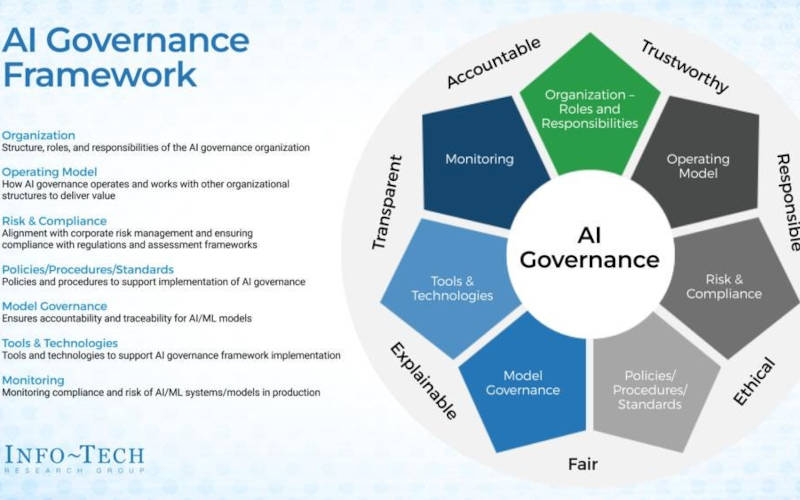
- Governance Framework: Embed GenAI into existing risk and compliance governance (no silo). Establish cross-functional AI risk committees or steering groups (including risk, compliance, legal, IT, and business units) as recommended by regulators. Update risk inventories and control libraries to include generative AI activities. Define clear accountability: assign senior management oversight, ensure first-line business owners “own” AI-driven processes, and maintain audit trails.
- Policies & Oversight: Develop or update AI-specific policies: acceptable use rules, data handling guidelines, and incident response plans for AI. Incorporate GenAI into vendor management policies: perform due diligence and require third-party audits or certifications. Ensure any use of external LLMs complies with regulatory outsourcing rules (e.g. FCA’s SYSC 8/9, OCC guidance).
- Model Validation & Testing: Before production, rigorously test AI models. Validate that outputs are accurate, unbiased, and relevant. FINRA advises testing GenAI for privacy, integrity, reliability and accuracy. Perform adversarial and scenario testing (including prompt robustness and hallucination triggers). Document test results and create checklists (e.g. bias audits, data leakage tests). Retain human-in-the-loop during evaluation phases.
- Monitoring & Logging: Implement continuous monitoring of GenAI use. Log prompts, model versions, outputs, and feedback for auditability. Track performance metrics (accuracy, drift, false positives). Schedule regular model retraining or refreshes to incorporate new data. Establish alerts for anomalous behavior or output patterns. Automated monitoring tools (as suggested by GARP) can detect drift, bias or security issues in real-time.
- Access Controls: Restrict GenAI capabilities to authorized personnel. Use role-based access to AI tools and data. Mask or remove sensitive PII from prompts when possible. For proprietary or regulated data, prefer on-premise or private cloud models. Apply encryption and data governance controls to training data and inference logs.
- Data Lineage and Quality: Maintain data provenance: know what data (internal/external) was used to train or fine-tune models. Document lineage to meet auditing needs. Prioritize data quality and governance initiatives so models learn from accurate, up-to-date information. For public LLMs, implement data filters or “guard rails” to block outputs that violate policies.
- Documentation: Create AI Model Cards or datasheets for each GenAI solution, detailing its purpose, training data scope, limitations, and governance controls. This ensures transparency and aids audit reviews. Maintain clear records of human oversight procedures, versioning, and risk assessments. As NIST and others recommend, document model capabilities and limitations so users understand when human review is required.
- Incident Response: Include AI-specific incidents (e.g. model hijacking, GDPR breach via AI, major hallucination event) in cyber and operational risk playbooks. Prepare to disable or rollback AI features if compliance issues arise. Conduct post-incident reviews to improve controls and update governance policies.
- Training & Culture: Educate staff on GenAI benefits and risks. Training should cover ethical AI use, data privacy, and how to craft safe prompts. Encourage an “AI-literate” culture where front-line users can identify AI errors (bias or hallucinations) and escalate concerns. As UK regulators note, building human oversight requires culture change and upskilling.
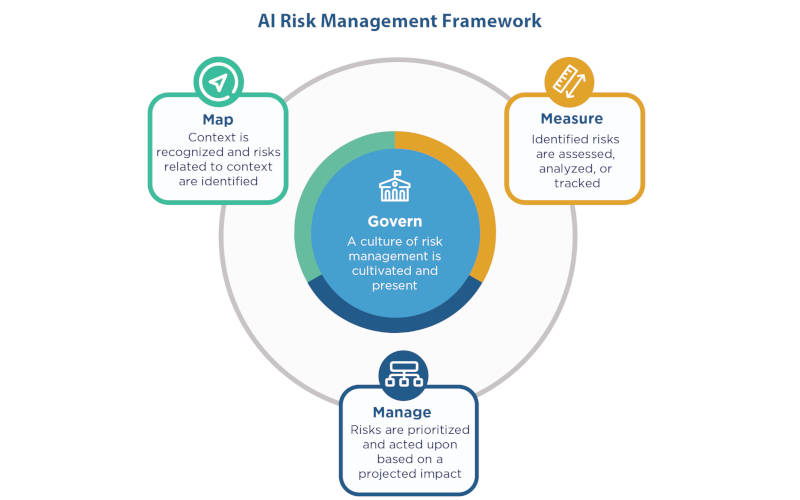
Key points: Firms must treat GenAI governance as an extension of existing risk frameworks. Controls like model validation, human review, data controls, and vendor oversight are critical. Industry guidance (e.g. NIST AI RMF) stresses updating risk inventories and continuously measuring performance. With robust governance, GenAI can be deployed “fairly, responsibly and transparently”.
Implementation Roadmap and Checklist
Embarking on GenAI requires a phased, well-governed approach:
Strategy & Assessment:
- Assemble the team. Form a cross-disciplinary GenAI steering group (risk, compliance, legal, IT, data science, business). Secure C-suite sponsorship (CIO/CRO) to ensure resources and risk appetite alignment.
- Use-case selection. Identify a shortlist of high-impact, manageable use cases (e.g. drafting reports, KYC reviews). Prioritize areas with clear inefficiencies or manual bottlenecks. Ensure each case has defined metrics.
- Regulatory review. Engage compliance/legal to vet proposed use cases against regulations (e.g. can AI generate parts of a required report?). Document compliance criteria (e.g. “AI can draft MD&A commentary, subject to human approval”).
Governance Setup:
- Update risk policies. Include GenAI in model risk and IT risk frameworks. Define oversight processes for AI projects (e.g. approvals, change management). Establish an AI vendor management process for any third-party models.
- Define controls. Plan data governance (data sourcing, anonymization), security (API/infrastructure security), and privacy measures (prompt filtering). Incorporate data lineage tracking.
Pilot Development:
- Build and test a prototype. For each use case, develop a minimal-viable AI solution (e.g. a chatbot for compliance Q&A, a model to summarize alerts). Use internal or open-source LLMs where possible to control data.
- Validation. Rigorously test for accuracy, bias, and compliance. FINRA suggests areas like privacy, integrity, reliability. Engage end-users early (e.g. KYC analysts, compliance officers) to provide feedback. Ensure a human-in-the-loop for final decisions.
- Metrics. Measure pilot outcomes: time saved, accuracy (e.g. how many frauds detected), compliance quality. Compare against baselines (e.g. manual processes). Document lessons learned.
Iterate and Scale:
- Incorporate feedback. Refine prompts, retrain models, improve data quality based on pilot results.
- Expand use. Roll out GenAI tools to more teams/regions in phases. Maintain constant monitoring of performance and user feedback. As McKinsey notes, scale only after proving positive impact in a controlled setting.
- Continuous governance. Update controls and policies to cover new AI deployments. Automate logging and monitoring (version tracking, output audits) as more AI models go live. Periodically reassess AI vendor risk and compliance.
Ongoing Maintenance:
- Monitoring and Auditing. Set up ongoing dashboards for AI metrics (accuracy, bias indicators, usage stats). Conduct regular audits and refreshers. Update models with new data (e.g. latest regulations, transaction patterns).
- Regulatory alignment. Stay abreast of new rules (EU AI Act, NIST updates, SEC guidance). Be prepared to adapt (e.g. integrate AI risk in stress tests).
Also read:- Rise of Agentic AI in Credit Risk Management in Banking
Real-World Case Studies
- Global Bank – KYC/AML Automation: A leading bank restructured its entire customer due diligence process using agentic AI. It built an “AI factory” with 10 agent squads to handle end-to-end KYC onboarding. Each squad had specialized AI bots (e.g. data extraction, ownership analysis, sanctions screening). The final output was a consolidated KYC file with a recommendation memo for a human reviewer. The system automatically logged every decision path for full auditability. Result: Analysts now review summaries rather than raw data, massively cutting manual hours and improving consistency. Key enablers were granular process mapping, QA agents for each step, and redesigning processes for straight-through processing.
- Canadian Bank – Finance Reporting: In early 2026, a major Canadian bank’s finance division piloted GenAI for regulatory reporting. They implemented three proof-of-concept use cases: (1) an executive earnings assistant that auto-generated draft analyst reports and earnings-call summaries; (2) AI-augmented writing of MD&A (management discussion) commentaries; and (3) an LLM-based data-extraction tool for peer-analytics. Each case significantly reduced manual work. For example, the earnings assistant improved timeliness and consistency of reports, allowing the team to focus on analysis rather than drafting. After these wins, the bank saw measurable value (faster outputs, fewer errors) and is now planning an internal AI platform and agentic roadmap.
- Mastercard – Fraud Detection: Mastercard employed GenAI-based predictive models to fight card fraud. By analyzing transaction data and external signals, its AI engine achieved a 200% reduction in false positives. This greatly lowered manual review workload and improved customer experience. The model flags were tuned such that normal customer behavior (even if unusual for others) is less likely to trigger alerts. Similarly, Barclays uses AI to learn customer spending patterns: transactions deviating from an individual’s norm are flagged, while common anomalies (for that customer) are ignored. These examples show how GenAI can refine surveillance rules for better precision.
- BNY Mellon – Settlement Risk Prediction: BNY Mellon, with Google Cloud, built an AI model to predict settlement failures in securities processing. The model forecasted 40% of potential fails with 90% accuracy. Though not a compliance task per se, this AI initiative demonstrates how banks are applying advanced AI to mitigate financial risks (and reduce regulatory scrutiny on settlement processes).
- Insider Trading Surveillance (Industry Example): While not AI-generated, a real case underscores the need for continuous monitoring: the FCA prosecuted an insider trading ring that hid illicit trades via complex account schemes, caught only by diligent surveillance systems. Generative AI could enhance such systems by better spotting unusual narratives or network relationships in data.
These case studies illustrate tangible benefits: huge productivity uplifts, audit trails, and strategic impact when GenAI is deployed with sound governance. They also underscore the importance of starting small (pilot a segment of KYC or a report type) and scaling after success.
Risks vs Mitigations
| Risk / Challenge | Mitigation Strategy |
|---|---|
| Bias / Fairness: Model outputs favor or disfavor groups based on skewed training data. | Perform bias audits and fairness testing; ensure diverse, representative training data; apply debiasing techniques. Monitor outputs for adverse impact. |
| Inaccurate / Hallucinatory Output: AI generates wrong facts or plausible but false content. | Use retrieval-augmented generation (ground LLM on verified sources); implement human review of critical outputs; fact-check against databases. |
| Explainability / Auditability Gaps: Black-box decisions hard to justify to regulators. | Maintain detailed logs of prompts/responses; develop model cards; use interpretable models for high-stakes decisions; document decision rationale. |
| Data Privacy & Leakage: Sensitive data exposed in training or output. | De-identify or anonymize data before training; implement input/output filters; use private or on-premise models for PII; apply differential privacy techniques. |
| Third-Party/Vendor Risk: Dependency on external AI services and their vulnerabilities. | Conduct rigorous vendor due diligence; include AI-specific clauses in contracts; plan vendor fallback or data portability; regularly audit third-party controls. |
| Security (Adversarial Attacks): Attackers exploit AI (e.g., prompt injection, model stealing). | Perform adversarial testing; apply input sanitization; limit model access; monitor for abnormal usage patterns; integrate AI into security operations center. |
| Regulatory Non-Compliance: AI-driven processes violate laws or guidelines. | Engage legal/compliance in AI use case design; align with AI Act and financial regs; include compliance checkpoints; get approvals for high-risk models. |
| Model Risk (Data Drift): Model degrades over time or is misused off-label. | Set up continuous performance monitoring; retrain/update models on new data; restrict model domains; classify GenAI systems as high-risk under internal policy and apply model risk management. |
The above table pairs each key risk with corresponding safeguards. As regulators stress, it’s crucial to blend technical controls (testing, monitoring, access management) with organizational measures (governance, accountability).