IFRS 9 staging hinges on assessing if a loan shows a Significant Increase in Credit Risk (SICR), guiding classification and accounting for ECL.
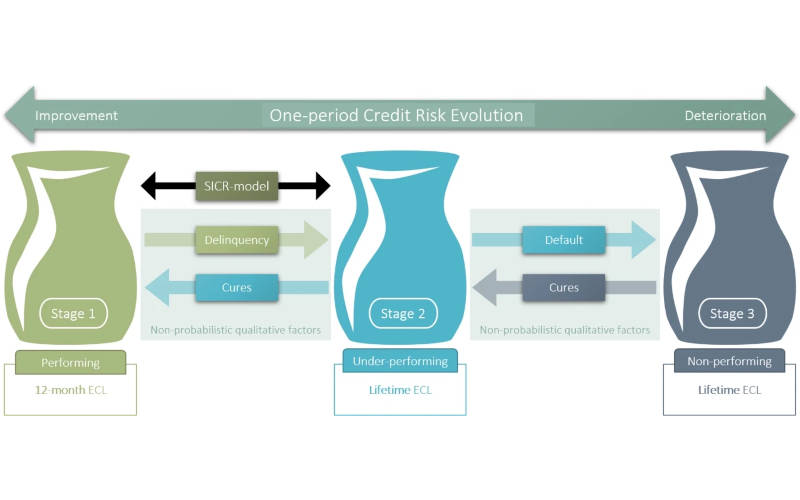
IFRS 9 replaced the old “wait until it defaults” mindset with a forward-looking expected credit loss (ECL) framework. But the part of that framework where models, accountants, and regulators most often collide isn’t the loss calculation itself. It’s the staging decision — specifically, the assessment of whether a loan has experienced a Significant Increase in Credit Risk (SICR).
Get staging wrong and everything downstream is wrong: your provisions, your coverage ratios, your P\&L volatility, and ultimately the story your balance sheet tells investors. So it’s worth slowing down on what staging really is and why SICR remains one of the most judgement-heavy areas in the entire standard.
The Three-Stage Model in IFRS 9 Staging
IFRS 9 sorts every exposure into one of three buckets, and the bucket determines how much loss you provision for.
Stage 1 covers performing assets that haven’t deteriorated significantly since origination. Here you hold a 12-month ECL — the losses expected from default events possible within the next twelve months.
Stage 2 is where an asset lands once it has suffered a significant increase in credit risk but is not yet credit-impaired. The provision jumps to lifetime ECL — expected losses over the entire remaining life of the exposure. This is the cliff edge, and SICR is the trigger that pushes an asset over it.
Stage 3 captures credit-impaired assets — the ones showing objective evidence of default. Provisioning remains lifetime ECL, but interest revenue is now recognised on the net carrying amount rather than the gross.
The dramatic accounting event is the move from Stage 1 to Stage 2, because provisions can multiply several times over the instant an asset crosses that line. That single transition is why SICR gets so much attention from auditors and supervisors.
What “Significant” Actually Means
Here’s the uncomfortable truth: IFRS 9 deliberately does not define “significant.” The standard gives principles, not thresholds. It expects each institution to build its own SICR methodology, defend it, and apply it consistently. That flexibility is a gift and a trap — it lets banks tailor the assessment to their portfolios, but it also makes the whole exercise a magnet for challenge.
The anchor of a proper SICR assessment is relative change in the risk of default over the remaining life of the instrument, measured from the date of initial recognition. Two ideas inside that sentence trip people up constantly.
First, it’s relative, not absolute. A loan that was originated as subprime and stays subprime hasn’t necessarily experienced SICR — its risk hasn’t meaningfully worsened relative to where it started. A prime loan whose default probability triples might trigger SICR even while remaining lower-risk in absolute terms than the subprime loan next to it. Comparing lifetime PD at the reporting date against a fixed absolute threshold is a classic error.
Second, it’s about lifetime risk, not the 12-month view. You must compare the remaining-lifetime PD at the reporting date against the remaining-lifetime PD that was expected for that same point in time when the loan was first recognised. That origination-date expectation is your baseline, and building it correctly is half the battle.
Also read :- Rise of Agentic AI in Credit Risk Management
The Three Pillars of a SICR Assessment
Most banks operationalise SICR through a combination of quantitative, qualitative, and backstop indicators — and IFRS 9 effectively requires all three to work together.
The quantitative test typically compares lifetime PD at reporting against the origination baseline, using either an absolute or relative threshold (or both). Relative thresholds — for example, a doubling of PD combined with a minimum absolute change — have become common because they behave more sensibly across risk grades than a single flat cut-off.
Qualitative indicators catch deterioration that the PD model may not yet reflect: watchlist status, forbearance flags, breaches of covenants, adverse changes in the borrower’s business, or a downgrade in internal rating. These matter because models lag reality, and a borrower can be visibly in trouble before the numbers move.
The 30-days-past-due backstop is the standard’s safety net. IFRS 9 contains a rebuttable presumption that credit risk has increased significantly once contractual payments are more than 30 days overdue. You can rebut it with evidence, but you must have that evidence — you cannot simply ignore the trigger.
Where It Gets Genuinely Hard
Three practical problems keep staging teams busy long after the methodology is signed off.
Threshold calibration. Set SICR thresholds too tight and you flood Stage 2 with assets that don’t belong there, inflating provisions and creating earnings volatility. Set them too loose and you fail to capture real deterioration, understating risk and inviting a regulatory finding. There is no universally correct threshold — only one you can evidence and defend for a given portfolio.
Transfers back to Stage 1. SICR is symmetric: if the conditions that pushed an asset into Stage 2 reverse, it should transfer back. But banks often apply a probation or cure period before allowing that move, to avoid assets bouncing between stages every reporting date. How long that period should be is another judgement call.
Forward-looking information. SICR is not a rear-view exercise. You must incorporate reasonable and supportable forward-looking macroeconomic information — and often multiple weighted scenarios — into both the PD estimates and the assessment. This is where staging connects directly to your ECL scenario design and stress-testing frameworks, and where the subjectivity compounds.
Also read :- Building a Basel Model in Credit Risk
Why This Deserves Your Attention
Staging is the pivot point of IFRS 9. The elegance of the ECL calculation is almost irrelevant if assets are sitting in the wrong stage, because the stage dictates the entire provisioning horizon. And because SICR rests on institution-specific judgement rather than a bright-line rule, it is perennially the first thing auditors probe and supervisors benchmark across peers.
For anyone building or validating these models, the practical takeaways are consistent. Anchor the assessment on relative, lifetime deterioration measured from origination. Use quantitative, qualitative, and backstop triggers in combination rather than relying on any one. Document every threshold and every rebuttal, because “significant” is whatever you can defend — and one day you will have to defend it.
Staging won’t ever be a purely mechanical process, and that’s by design. The best a risk function can do is make its judgement transparent, consistent, and evidenced. In a framework built on estimating losses that haven’t happened yet, that discipline is the whole game.